The generals’ pilot, Capt. Lynch
“Hold on General. We’ve got to go in!”
General Walker arrives on the scene
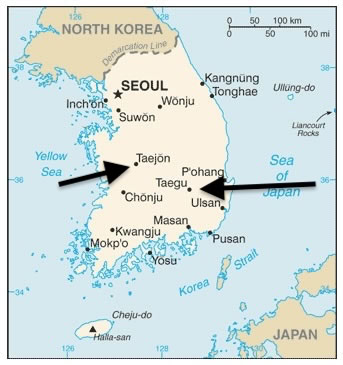
Lieutenant General Walton “Johnny” Walker set up his headquarters, EUSA, at Taegu, ROK, about 145 miles southeast of Seoul. General Dean, the 24th ID commander, placed his headquarters at Taejon, about 80 miles south-southeast of Seoul.
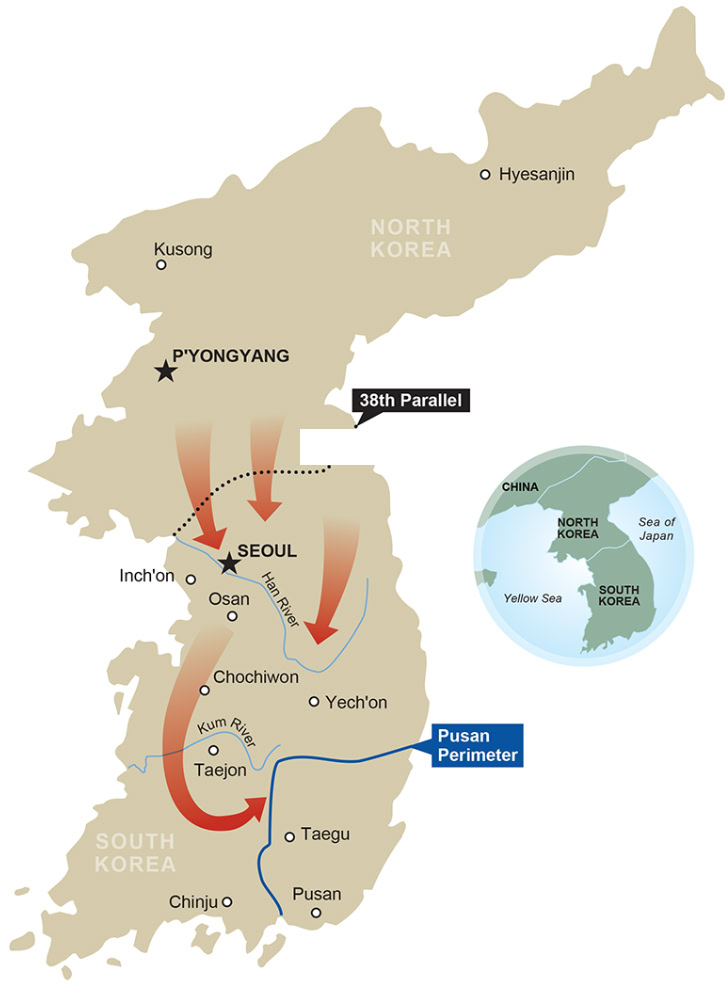
From the outset, General MacArthur planned to destroy the North Korean Army and unite the Korean Peninsula. However, it’s late June 1950, the North Koreans had crossed the 38th parallel and captured Seoul, so MacArthur was on the defensive. The North Korean invasion stunned the American leadership, civilian and military. MacArthur figured he would need three Army divisions to stop the advance. For the moment, he only had one, the 24th ID.
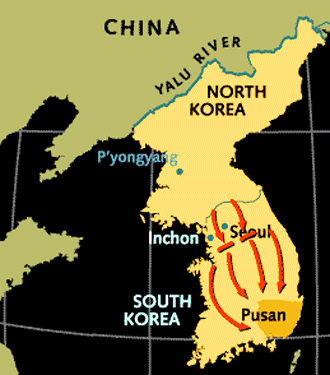
Walker realized his 24th ID couldn't withstand the enemy attack. He reckoned he would have to establish a strong position in southeast ROK, which would become known later as the Pusan Perimeter. But first, Walker needed to slow the enemy’s advance until reinforcements arrived from Japan and the US. ROK Army (ROKA) forces were panicking as they retreated southward, and the 24th ID was arriving piecemeal.
On July 7, 1950, two weeks after the invasion, General Walker flew from Japan to Taegu. The 24th ID was stretched from Taejon down to Pusan in the far southeast. It was no match for the North Korean assault.
On July 10, the UN Security Council (UNSC) directed the establishment of a unified Korean Command with General MacArthur as the Commander-in-Chief, UN Command (UNC). ON paper, thje wart was a UN war.
Word arrived that the enemy was crossing the Kum River at Kongju and was only about 15 miles northwest of Taejon. Walker knew that holding the line at Taejon with the 24th ID’s 34th Regiment would be difficult. On July 14, Walker summoned his pilot, Capt Mike Lynch, telling him to fly over the battlefield to observe the situation.
While in the air, General Walker listened to radio transmissions from the ground combat units and heard Air Force pilots report their targets. The ground forces were being devastated. John Toland said, “The general was shocked” and said the scene was one of “carnage.” Walker concluded he would have to accelerate his defensive plan to the southeast.
Upon landing, he instructed his operations chief, Colonel Allan MacLean, to board the aircraft and identify the best defensive positions along a line drawn on a map by Walker that would later become the Pusan Perimeter, far to the southeast. Walker confirmed in his mind that he would have to fall back behind this line.
Walker felt confident that Capt. Lynch, a combat infantryman, would be invaluable to the colonel. Walker said, “Mac, I want you to find the best defense positions as far forward of that line as possible. Lynch will fly you. As a combat infantryman, he knows the terrain. Use my plane.”
MacLean asked how far forward of that line he should go. Walker responded, “Keep flying until they shoot at you!”
By July 14, the enemy overran 24th ID forces, which had to withdraw, and the ROKA forces were doing the same. On July 17, General Walker was notified he would command all friendly ground forces in Korea. Thankfully, the 1st Cavalry Division started arriving at Pohang port on the east coast on July 18, but it would take a few days to get it into the fight.
Walker headed over to the Taejon airstrip and decided to get up in the air again. The enemy was on the outskirts of the city. Walker told Lynch to fly south so he could assess the road to Kunsan on the western shore of Korea. US reconnaissance troops occupied a ridge south of Taejon, so Lynch made some low passes along the ridge. Lynch dropped to the same elevation as the ridge. Walker examined the fields of fire. They returned to Taegu, seventy miles southeast of Taejon,
By July 20, enemy tanks were seen outside Taejon. Capt. Lynch flew Walker’s operations chief, Colonel MacLean, to Taejon. Artillery was hitting the airstrip, MacLean did what he could under pressure, and they returned to Taegu.
In the meantime, the 1st Cavalry was assembling south of Taejon. General Dean still hoped his 24th ID could hold the line.
Later in the afternoon of July 20, an Air Force major arrived at Taegu and told Lynch to fly him to Taejon under orders from Walker. Lynch told him the airstrip was receiving artillery fire, but the major insisted he was following General Walker’s orders to get an air liaison officer over to Taejon right away.
Lynch was unsure if the airstrip was open, but he took off anyway. Lynch flew on the deck and “slipped into the Taejon airfield and parked near several infantrymen in a foxhole." Those men hollered, “Get the hell out of here,” saying the enemy was in some buildings across the way. They were right. Lynch’s aircraft was hit by enemy fire. He knew he had to get out of Taejon. He couldn’t taxi to the airstrip, so he decided to take off across it to get airborne.
It was clear to Lynch that US ground forces couldn’t hold their position. By the grace of God, Lynch and Colonel MacLean managed to return to Taegu. The enemy broke through and captured Taejon. General Dean was wounded and tried to escape on foot to reach Taegu, but he was betrayed by two Koreans and taken prisoner.
By July 29, Walker, having flown over most of the battlefield, confirmed his earlier sense that he would need to establish a “horseshoe defense in front of Pusan with Taegu as the apex,” which became known as the “Pusan Perimeter,” between the Naktong River and the sea. This is where Walker intended to make his last stand.
On this date, General Walker issued his “Stand or Die” order to his division commanders,
“We are fighting a battle against time. There will be no more retreating, withdrawal or readjustment of the lines or any other term you choose. There is no line behind us to which we can retreat .…There will be no Dunkirk, there will be no Bataan. A retreat to Pusan (port city) would be one of the greatest butcheries in history. We must fight until the end .…We will fight as a team. If some of us must die, we will die fighting together .… I want everybody to understand we are going to hold this line. We are going to win.”
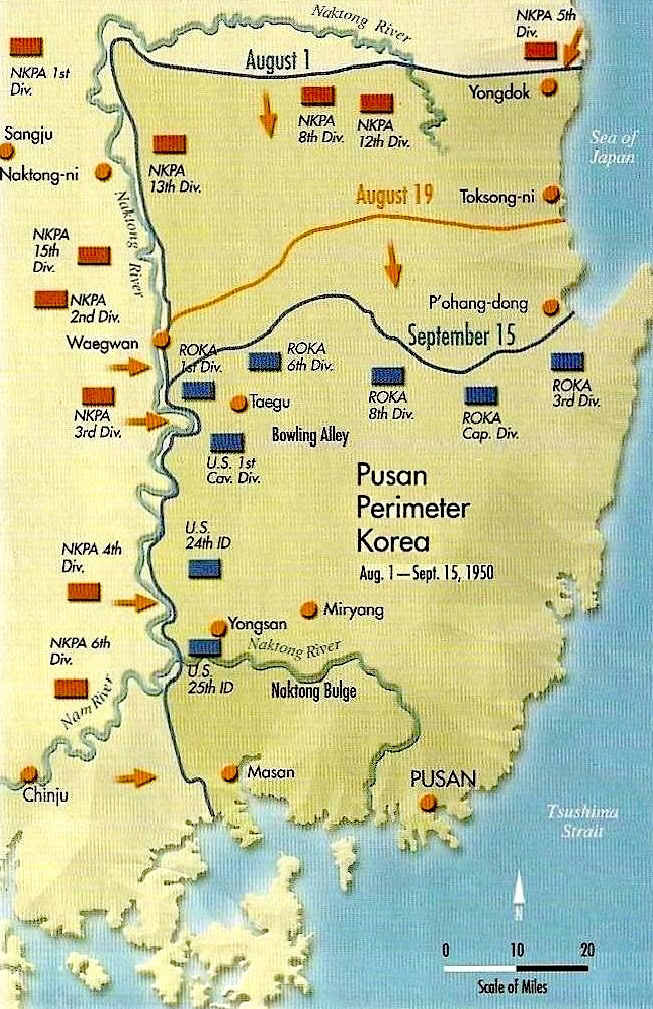
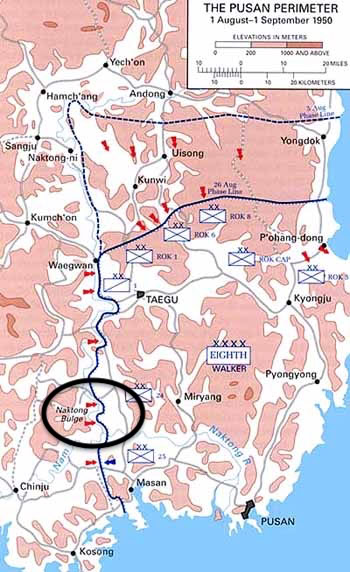
Walker’s next agenda item was to determine the best way to deploy his troops to and within the Perimeter. This map, presented by the 1st Cavalry Division, shows well what confronted General Walker.
The Naktong River was the boundary of his original Pusan Perimeter, extending to the north on this map, labeled “August 1.”
The line enveloping his troops was 140 miles long. He went out daily with Capt. Lynch or Major General Earle Partridge, the commander of the 5th Air Force (AF), piloting the aircraft. They reconnoitered enemy positions at low altitudes, and Walker assessed how to position his remaining forces.
The North Koreans pressed the entire Pusan Perimeter in early August 1950, and they maintained their pressure through part of September in what has been called the Great Naktong Offensive. Walker’s force had to fall back to a line south of the original line labeled “August 19.” And then his forces fell back to another line labeled “September 15.” The EUSA broke out of the Perimeter on about September 15, with its back to the wall.
Walker’s big concern in early August was in the southwest, at a place known as the Naktong Bulge. Enemy forces started crossing the Naktong River in this area on August 5-6, 1950. The river curves west and forms a semicircle. The river here runs to a depth of about six feet, which enabled infantry to wade across. Vehicles would have a harder time, but could get across with assistance. The North Korean 4th Division attempted to cross at the Bulge but had been repulsed by the 24th ID reinforced by troops held in reserve and Marines.
Following the confrontations in early August, General Walker assigned the newly arrived 2nd ID commanded by a general whom Walker did not know and commanded by men who had not led in battle, to defend the Bulge, thinking it was now the least threatened sector. However, on September 1, Major General Lawrence Keiser, the commander of the 2nd ID, called Walker to say his forward units were under attack.
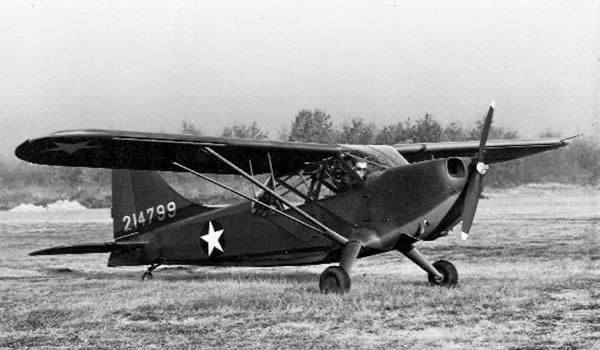
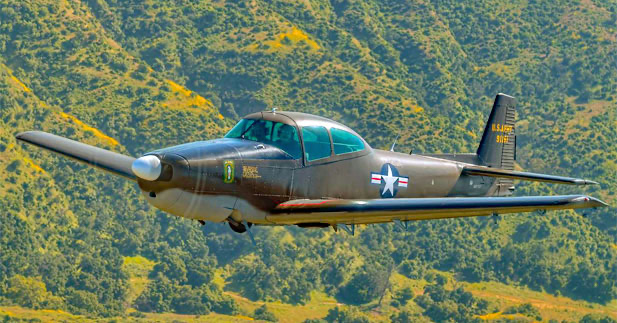
This confused Walker, so he dashed over to the Taegu airstrip and told Lynch to get him airborne in the L-5 so he could observe the critical area. The L-5 allowed Lynch to get close to the ground and land if needed.
Once in the air, Lynch asked him where he wanted to go, and Walker replied, “I don’t know where we should start, but there’s one area we can’t let them through, and that’s the Naktong Bulge.” He knew the enemy was building sandbag bridges underwater to facilitate crossing. He told Lynch to fly low and discovered the enemy was attacking in a gap between two US regiments, which could give it a direct shot into Pusan.
Walker told Lynch to fly even lower so Walker could see if enemy penetration included enemy armor. The Perimeter would be in serious trouble if tanks could drive across the Naktong using those sandbag bridges.
The L-5 was a two-seat aircraft, but they were not to use the intercom, so Walker yelled, “Mike, could we make it through if we try to go down the river? We’ve got to see how many are coming across and if they have armor.”
Lynch descended to the area where they were skimming the water. Lynch pushed his engine to the limit. Lynch looked to the right while Walker looked to the left. The wheels of the L-5 occasionally touched the water. Both Lynch and Walker scanned for tank tracks. Enemy troops saw them flying, but Lynch was going too fast for them to get a clear shot. To Walker’s relief, they found no tank tracks, leading him to conclude that the tanks had not crossed, at least not yet.
They then returned to where American troops were deployed to defend the Bulge. Walker was surprised, perhaps even shocked, and yelled, “God. They’re not even massing where they should! We’ve got to stop them! I’ve got to talk to them!,” but there was no place to land.
Lynch understood the problem and said, “Okay. I’ll get up high enough and then kill the motor and hope it’ll start again. We’ll come right down over their heads, and you can yell at them.”
Lynch took the L-5 “up to two hundred feet, cut the throttle, and lowered the flaps. The back door was dropped, and Walker leaned out and shouted, ‘Get back there, you yellow sons of bitches! Get back there and fight.’ He turned to Lynch, ‘Have you got three stars on the plane?’”
Lynch didn't have the three stars on the plane, but he did have a star flag of his own, and he took it out and stuck it out the window. Lynch had the engine running so low he was close to stalling, and Walker kept yelling at the soldiers. They had been flying over this area for about 20 minutes and started to draw enemy fire. Lynch said they had to get out.
They then flew down a road and saw trucks approaching from both directions. Lynch brought her down again, this time to about 50 feet. Walker decided the situation was stabilizing and told Lynch to fly to the 2nd Division’s headquarters. They did, and Lynch landed on the road.
Walker jumped out and went over to Major General Laurence “Dutch” Keiser, the division commander. After questioning Keiser, Walker saw that Keiser did not know what was going on and said firmly, “I’m not going to lose this battle.”
They returned to the L-5, and Lynch commented, “This is the Battle of the Bulge (WWII) revisited. Nobody (including General Keiser) knows what’s going on, rumors are rampant. Guys are panicking for no reason and people are saying the enemy is all over.”
John Toland commented in his book, “Walker said nothing but suddenly rested his hand on the map. Tears rolled down his cheeks. ‘Here I’m losing the whole army and I can’t do anything about it.’”
Toland added, “Lynch felt bitter. He hated everyone above Walker and everyone below. But that’s what you get, he thought, when you take a bunch of administrative guys and give them a command in peacetime so they can get promoted.”
General Walker had tasked Brigadier General Garrison Davidson, USA, to sketch out a secondary line of defense to the rear of the current Perimeter. It was now time for Walker to get a close look at this line, the “Davidson Line.” He told Lynch to take him up. Lynch had reconnoitered the line several times. General Walker had him flying as close as 10 ft. above the ground. He could see the barbed wire and prepared positions. Most importantly, however, they could see the troops on the ground. They flew the full length of the line.
On their return, Lynch told General Walker he felt the men they had seen below were “ready to charge.” Walker had decided the night before he would fall back, but now agreed with Lynch and told his staff, “We’re holding.” He decided that, knowing that the North Koreans were pressing hard along the entire Pusan Perimeter, and he was going to lose his Marines to MacArthur’s plan for the Inchon Landings. Even his headquarters at Taegu was now at risk.
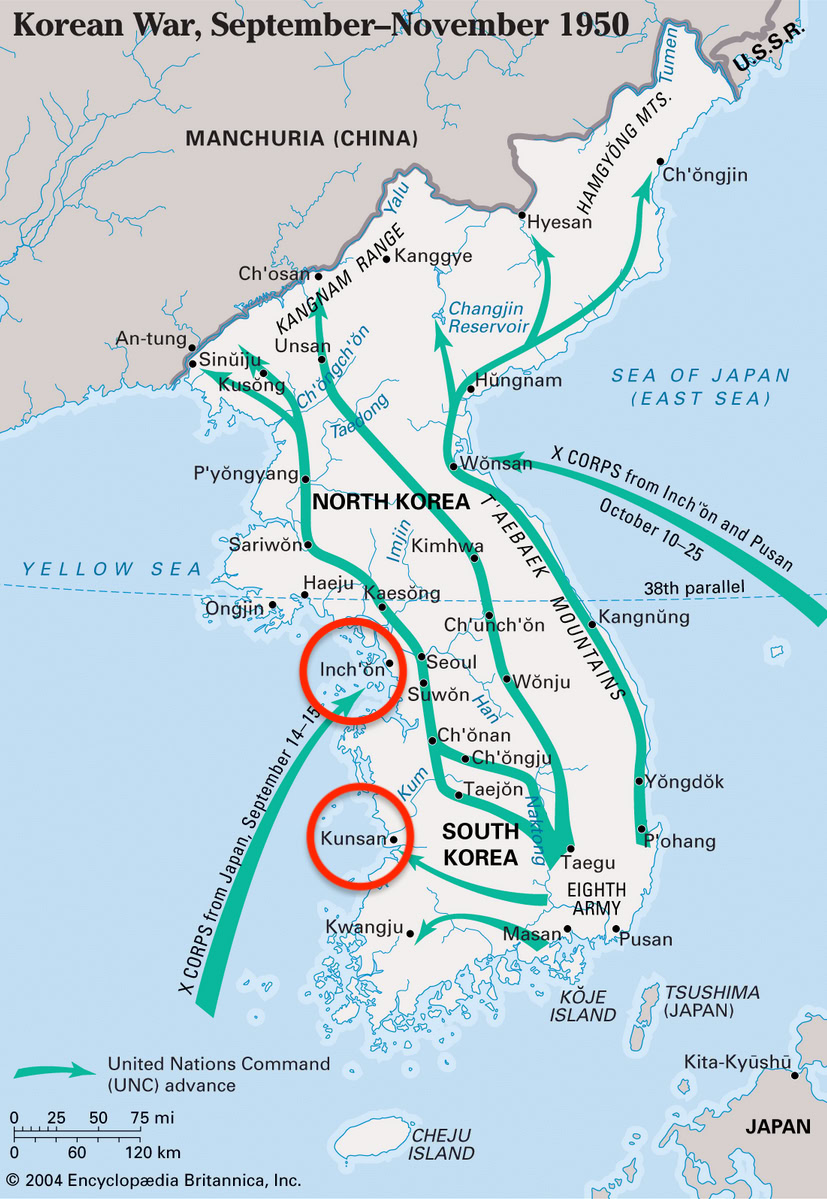
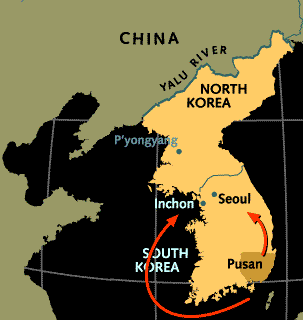
There was a high-level disagreement over whether to launch an amphibious assault at Inchon, close to Seoul, or Kunsan, which is farther south. MacArthur insisted on Inchon. Walker preferred a Kunsan landing and had planned the best way to break out of the Pusan Perimeter once it happened. Kunsan was closer to the Perimeter than Inchon.
After the decision briefing, which chose Inchon, Walker asked Lynch to fly along a route he had mapped out for his Kunsan plan.
Walker asked Lynch, “Which aircraft gives us a better chance of landing if we get hit?” Lynch chose the L-5. Walker then told his driver to put his shotgun in the aircraft, and the driver added four hand grenades. Lynch took his carbine. They were headed to the “Bowling Alley” on the L-5.
What or where is the Bowling Alley?
There is a road junction about 15 miles northwest of Taegu that the 27th Regiment of the 25th ID was defending. It was a narrow valley. The North Korean tanks had driven down one of the roads and fired their 85-mm guns on a flat trajectory at the 27th Regiment. These shells hit the first slight elevation and bounced into a nearby hillside, missing the dug-in troops altogether. They soon named this area the “Bowling Alley.”
Lynch flew to the Bowling Alley above the range of small-arms fire. They traveled north along the west side of the Naktong River, then headed west and northwest to a point slightly east of Inchon, then south to Taejon and back to Taegu. In short, they flew into the hornet’s nest, over enemy territory, occasionally at low altitude, then climbed higher. Walker’s goal was to assess the condition of the roads.
Walker noted that the roads from Chonan to Kunsan were empty, and concluded that they could have retaken Taejon if the landings had been at Kunsan! Walker lamented that they could have trapped the enemy forces between the Naktong and Kunsan had the brass listened to him. But the brass did not listen to him; he was a good soldier and pressed on.
Walker next instructed Lynch to fly near Chinju, far to the southeast, because he believed the enemy was aware they were flying around and might get a lucky shot if they went straight back to Taegu.
John Toland, in his book, remarked, “This trip of seventy-five miles behind the enemy lines was the deepest of any flight in the Korean War by Army aircraft.”
Walker told Lynch to take this risky trip to confirm that his plan was better than MacArthur’s!
General Walker was frustrated by several issues related to the Inchon landings. The operation planned to deploy about 75,000 troops, including Marines withdrawn from Walker, but he only had 47,000 troops available to defend the Perimeter. The landings would be heavily supported by a large naval force offshore, consisting of over 250 ships, while he was fighting against a major North Korean force of thirteen divisions, totaling perhaps 140,000 troops, with his back to the sea and no Navy.
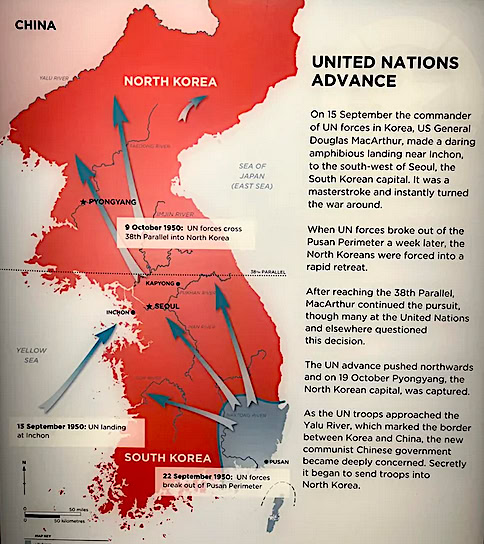
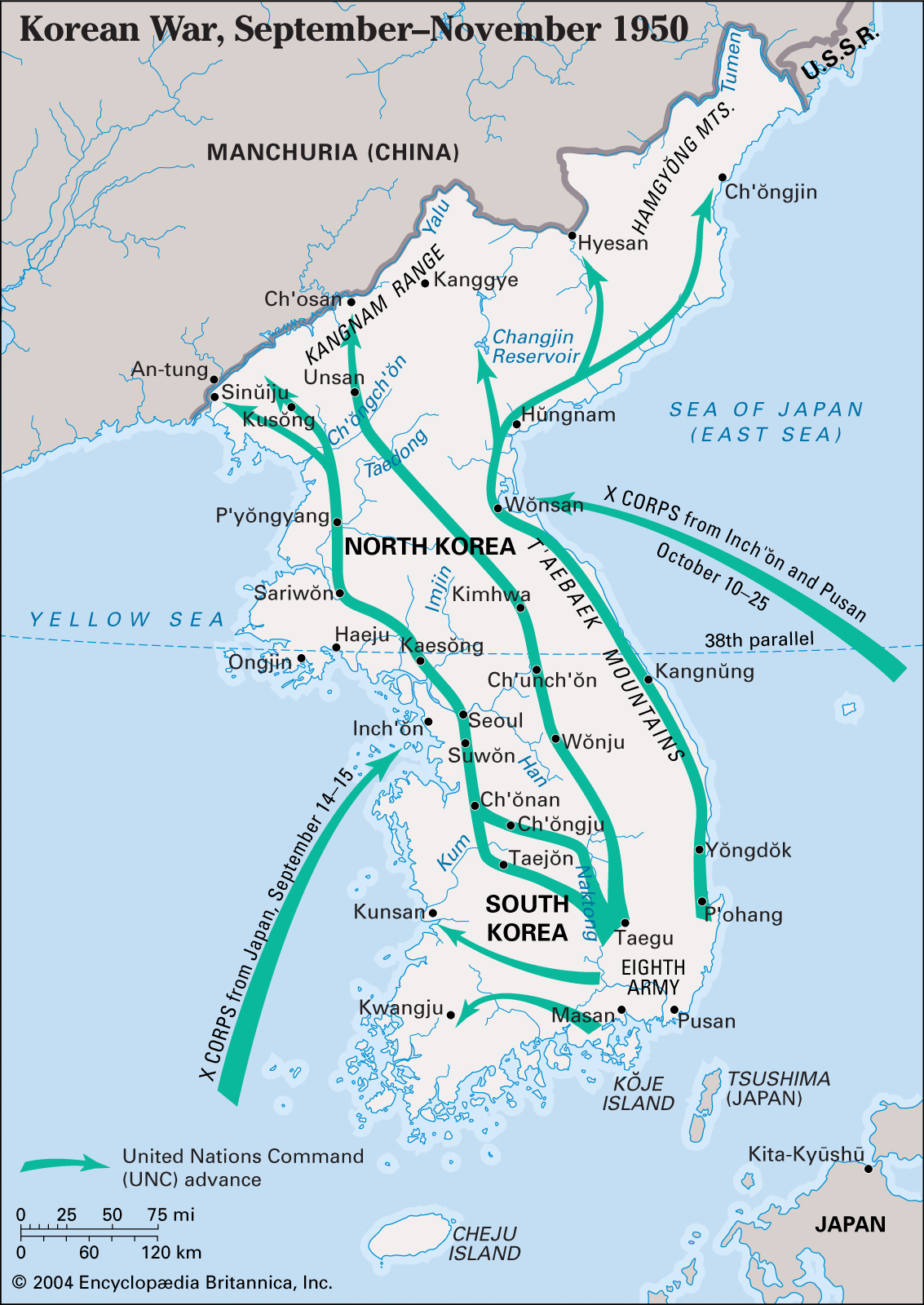
Well, the Inchon landings succeeded. That was a signal for Walker to launch an offensive to break out of the Perimeter. His 7th Cavalry Regiment broke out and crossed the Naktong River into enemy territory around September 22, 1950. Walker observed the attack from a plane flown by General Partridge and landed unexpectedly at Suwon airfield, about 20 miles south of Seoul, which was held by the 7th ID that had landed at Inchon.
Within days, Seoul was recaptured, and North Korean forces started retreating. Supported by the JCS, MacArthur reverted to his original idea to take all of Korea and reunite the peninsula. UN forces began crossing the 38th parallel.
On October 6, Walker and Lynch flew ahead of their troop positions to assess the threat. He informed MacArthur that he planned to march to Pyongyang, the North Korean capital.
But there was a dark omen in the air. Chinese Foreign Minister Chou En-lai told India’s ambassador to China that China would enter the war if the UN forces crossed the 38th parallel. They already had. The US leadership did not take this warning seriously.
Walker’s EUSA, consisting of US and Allied forces, was moving quickly up the east coast and reached Wonsan ahead of Major General Almond’s X Corps, which was approaching by sea.
Walker had hoped MacArthur would leave him in charge of X Corps, but that didn’t happen. Instead, MacArthur organized two separate thrusts: one by Almond’s X Corps coming from the east and the other by Walker's EUSA coming from the west. X Corps consisted of the Army's 7th ID and 1st Marine Division (MARDIV). The US military force in Korea was effectively split in two.
By November 24, 1950, Walker’s push was advancing north from the west in an offensive aimed at reaching the Yalu River border with China. Elements of X Corps were already at the Yalu at Hyesanjin. Back home, the JCS and President Truman were nervous and warned MacArthur to stay away from China.
General MacArthur arrived at an airstrip near the Chongsong about 40 miles northwest of Pyongyang. He boasted that the troops would be home by Christmas. After departure, he told his pilot to fly along the Yalu so he could get a look. They flew over what was believed to be enemy headquarters and then flew over the US troops at Hyesanjin.
MacArthur might have been elated, but General Walker was not. Capt. Lynch and the general’s aide, Major Layton “Joe” Tyner, noted their general was distraught. Privately, Walker had concluded that he needed to slow his force movements to the north until he could assess what the Chinese were doing. He disagreed with MacArthur. As fate would have it, the Chinese were already in North Korea. They were preparing for a massive counteroffensive.
General Walker now stepped up his airborne surveillance with Capt. Lynch, averaging four hours per day in the air. He observed the ROKA on his right flank collapsing, and their aircraft drew fire.
Lynch and Walker switched to the L-17, which was heated and flew over EUSA’s right flank, assessing the terrain, wondering if Walker would have to order a withdrawal. Lynch commented, “He wanted to go everywhere at once.”
Walker surveyed the perimeter of Pyongyang on November 1, worried that the Chinese could surround it and cut off the EUSA’s logistics route. During the flight, Walker saw the Chinese moving forward unopposed, well-equipped, and farther south than he had previously realized. Walker concluded he couldn’t defend Pyongyang and decided to withdraw to defensible positions, aiming to inflict as much damage on the Chinese as possible.
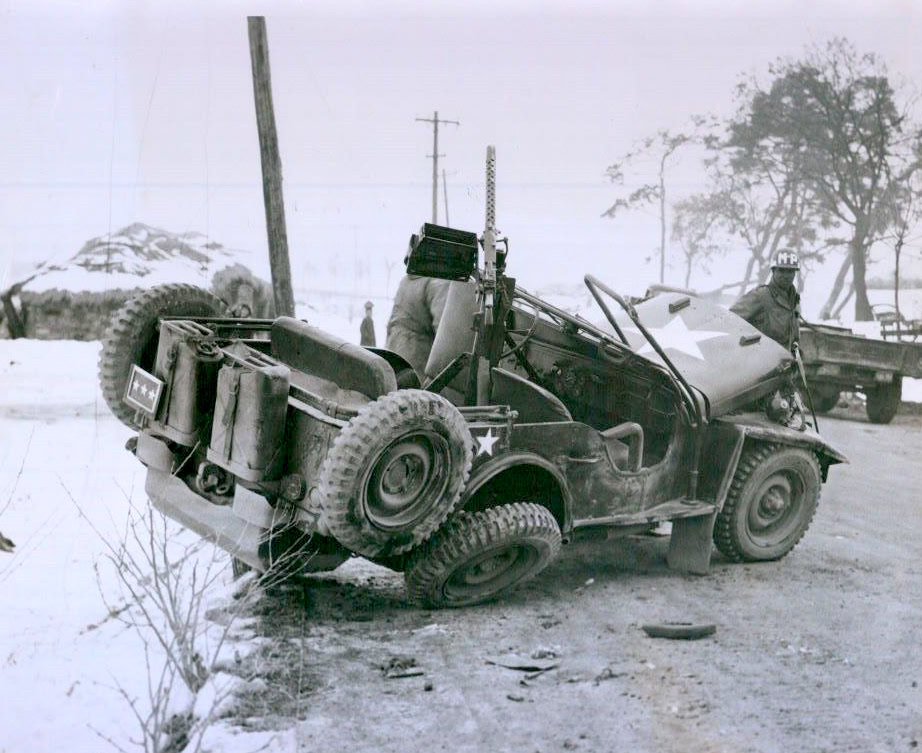
On December 3, General Walker traveled by jeep to visit his forces at Uijongbu, about 14 miles north of Seoul. He also intended to award the British Commonwealth Brigade. They drove by a column of trucks on the opposite side of the road. One of those trucks pulled out and collided head-on with Walker’s jeep. Walker was pinned under his jeep, and the windshield had smashed into his skull. He died.

Click to zoom graphic-photo


Ed Marek, editor

Marek Enterprise
224 N Barstow St Suite 426
Eau Claire, WI 54703
© Copyright 2025