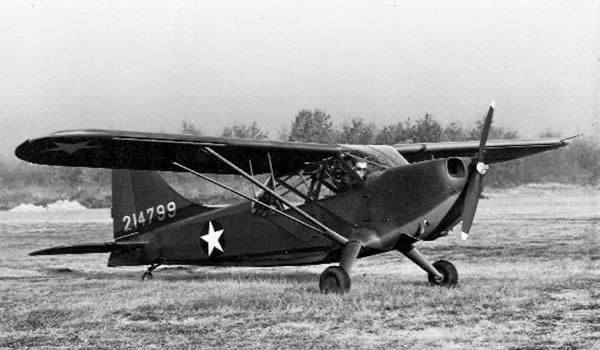
The generals’ pilot, Capt. Lynch
“Hold on General. We’ve got to go in!”
Introduction
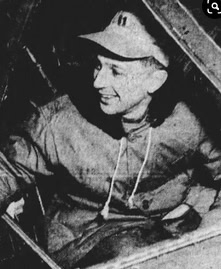
Captain Eugene Michael “Gene” Lynch, USA, served as the personal pilot for Lt. General Walton Walker, USA, and Lt. General Matthew Ridgeway, USA, when they led the Eighth US Army (EUSA) in the Korean War. This is a story about Lynch and his generals.
While reading In Mortal Combat, a book about the Korean War by John Toland, I was struck by Lt. General Walton “Johnny” Walker’s deep warfighting knowledge and by his pilot, Captain Eugene Michael “Gene” Lynch, USA, a pilot who seemed immune to danger, somewhat of a daredevil. On the one hand, he wanted to enable his general to see what he wanted, yet on the other, always mindful that he wanted to keep his general safe and sound for another day.
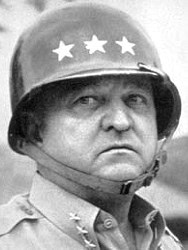
General Walker, a student at the Virginia Military Institute (VMI) and a graduate of West Point, was commissioned in the infantry, like most good soldiers. He fought in France during World War I. He served under General George Patton in Europe and later took command of the Eighth US Army (EUSA) in Japan during the occupation, and leading it during the Korean War. Alongside these combat roles, General Walker was an instructor at the artillery and infantry schools; he also served on the Army’s General Staff, commanded an infantry division, an armored division, and an Army corps that advanced from northern France to Austria. He was killed in a jeep accident between Seoul, Republic of Korea (ROK), and a new front line he had established during the Korean War.
“In his sixty-one years, Walker changed from the independent lad who chased girls home with a wooden sword, through a quite unruly cadet and a daring-do battalion commander, to the man who was never known to argue with a Patton order. The change never was complete, and he is revered as a compound of all these elements.”
Walker has been quoted as saying,
“All my life, I’ve been a soldier and nothing else.”
General Walker insisted on being present on the front lines. He did that in two ways.
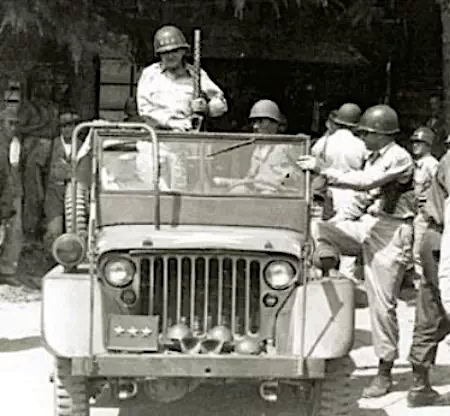
He had a modified Army Jeep especially for him with a .30-caliber machine gun mounted near the back seat. The seats were cushioned, the body armored, and it had a handrail he could grip. There was a shiny metal red flag with three white stars to assure all hands knew he was a lieutenant general when he came zooming through, the boss, their commander. Cognizant of weather conditions, he had oversized fenders and fender skirts to keep out the mud. The talk is that he loved speed, something his driver, Master Sergeant George Belton, also adored.
He was always near or at the front. His constant presence there showed the men in the fight that he wanted to see firsthand what was happening. This trait sent the message that he understood what they were enduring and that he cared about them. There was also a more strategic method to his madness: He wanted to assess the battlefield and adjust tactics and even strategy as he saw fit. On occasion, he would scold the troops.
Hal Boyle, an Associated Press reporter and columnist, wrote,
“The Little bulldog, a squat, plump, square-jawed Texan who looked more like a small-town businessman than an Army commander, proved before his death he could do both perfectly well … Walker rode about the front like a madman, standing up in his armored Jeep and gripping a handrail as he gave orders. The line bent, but never broke.”
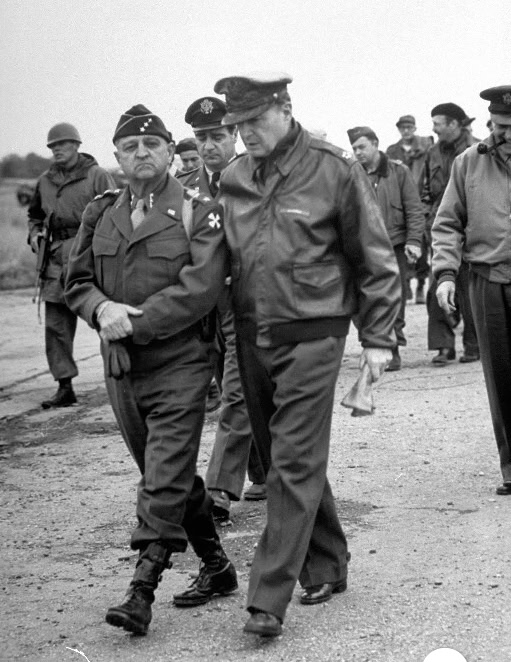
I love this photo of General Walker walking with General Douglas MacArthur, the Commander-in-Chief of UN Command in Korea. Walker almost looks like Mussolini, resolute, confident, understandable since he had a tough war on his hands and often disagreed with the flamboyant MacArthur, yet he remained a good soldier.
General Walker rode around in his jeep a lot. However, what caught my attention was how many times he grabbed his pilot, Captain Eugene Michael “Gene” Lynch, USA, and directed him to fly up and down the Korean peninsula behind his own lines, over the points of battle, and behind enemy lines, at varied altitudes and able to land on short notice with or without planning.
Capt. Lynch was from Green Bay, Wisconsin. He joined the Army as an enlisted man. After basic training in Texas, the Army sent him to the University of Cincinnati, where he graduated with an engineering degree in 1944 through the Army Specialized Training Program (ASTP). That was the good news.
The bad news was that the ASTP program was discontinued, so he joined the 19th Armored Infantry Battalion of the 14th Armored Division as a private. They landed at Marseilles, France, in October 1944 under the 7th US Army. They fought their way up to Alsace-Lorraine, France, after which they crossed the Rhine River into Germany. They were responsible for liberating towns, cities, and POW camps.
Lynch was promoted to staff sergeant, became a platoon sergeant, received a battlefield commission as a second lieutenant, and was later promoted to first lieutenant. He was then transferred to inactive status in the Officers’ Reserve.
Lynch was called up during the Korean War and was a captain. I’ll remark here that the rank of captain was my favorite during my USAF career. Captains have experience and a lot of wiggle room to do as is right or as they please. I think Lynch took advantage of that.
By 1968, he was a colonel and served as the commander of the 2nd Brigade of the 25th Infantry Division in Vietnam, and was a rated helicopter pilot. He retired at the rank of brigadier general.
Lynch was undeniably a brave man. He earned the Silver Star, the third-highest medal, in WWII Europe and in Vietnam. He also received the Distinguished Service Cross, the second-highest military award for extraordinary heroism in Vietnam, and was awarded eight Distinguished Flying Crosses.
I have assembled this story by drawing from John Toland’s book, focusing on Lynch’s airmanship and the relentless desire of his two generals to witness the action firsthand. I congratulate Toland for documenting Lynch’s interactions with his generals. Little is written about him elsewhere, so I aim to highlight him here.
Click to zoom graphic-photo

Ed Marek, editor

Marek Enterprise
224 N Barstow St Suite 426
Eau Claire, WI 54703
© Copyright 2025