The “Rice Paddy Navy”
“Go to China and set up some bases”
Get us the weather!
Introduction
We often think the Japanese attack on the Hawaiian Islands was a surprise. Perhaps the exact timing of it was, but Navy planners anticipated that such an attack was a likely scenario. The Navy began planning for war with Japan in 1897. Regrettably it did not plan for timely weather data.
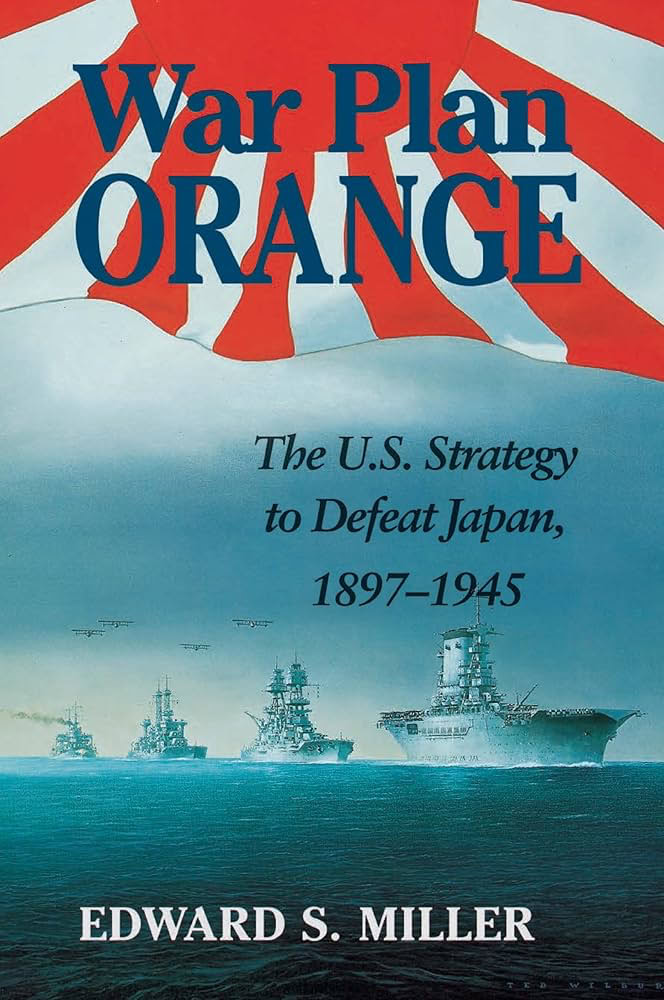
Edward Miller’s book, War Plan ORANGE: The US Strategy to Defeat Japan, 1897-1945, is partially available on the internet, thanks to the Naval Institute Press. This naval war planning was primarily done in secret.
It was evident to these planners in 1900 that the Marine Corps needed to develop expeditionary forces capable of rapid deployment. By 1920, the Navy decided it would plan its future in accordance with War Plan ORANGE; that is, Japan would be the future enemy, and the US had to plan to confront it in the Pacific.
As a result, the Navy directed the Marine Corps to be ready to launch expeditionary forces on short notice from the West Coast for a naval campaign in the Pacific. It later added the East Coast for Atlantic and Caribbean contingencies.
Amphibious warfare became a new mission for the Navy and Marines in 1927. Planning for this kind of warfare demanded that the Navy delve into covert operations. Doing so evolved into clashes with powerful centers of gravity.
American interest in the Pacific was China. China was seen as a potentially lucrative market for the US, a stepping stone to Japan, and a way to curtail European influence over the Far East.
The US Navy (USN) had interests in China that date back to as early as 1818. It employed gunboats to keep Chinese rivers, river ports, and ocean ports open to free commerce and to protect US interests and citizens.
In 1899, the US announced an Open Door policy toward China to promote equal opportunity for trade and commerce in China and respect China’s territorial integrity.
Ships of the Navy’s Asiatic Fleet visited China frequently. Sailors and Marines witnessed the infighting in China, observed Japanese naval activity in Chinese ports, and reported associated intelligence upstream. The dominant concern at the time was naval technology.
In 1894 -1895, Japan went to war against China and acquired supremacy over Korea and Formosa (Taiwan). In 1931, Japan invaded Manchuria, which had been the Russian sphere of influence, and spread its influence and control over much of eastern China.
The USN was no match for the navies of the world's powers, especially in the area of technology development.
The Navy sent its officers abroad to gain knowledge (to wit, spy) on foreign naval technology. The Navy relied heavily on ad-hoc spy networks and routine expeditions abroad, watching other navies and reporting back about them.
This was not going to cut the mustard. Lt. Theodorus Mason, USN, traveled abroad frequently and concluded the Navy needed an established and coordinated intelligence system. He advocated setting up an intelligence office within the Department of the Navy.
The Office of Naval Intelligence (ONI) was created in 1882, within the Bureau of Navigation. The ONI was the first permanent intelligence organization in the US. The Army followed suit in 1885.
In 1939, Commander (Cdr.) Milton Miles, a Naval Academy graduate who had served with the Asiatic Fleet in China, wrote a paper advocating a US Naval presence in China as a means to obtain intelligence on the Japanese, especially their technologies. This turned out to be an important paper.
Cdr. Miles drove the rapid evolution of a combined Sino-American organization that obtained sorely needed weather from China for the US Fleet in the Pacific and raised an irregular army to fight against Japan.
What’s the weather? Find out!
The US Navy in the Pacific during WWII relied on ground observers, aircraft patrols, and aerological reports to provide weather forecasts and warnings.
But the Navy had a huge shortfall as its forces became engaged in the Pacific War. Its fleets lacked good weather data. The farthest west the US had a weather station was Hawaii.
The National WWII Museum has said,
“Most meteorological data at this time came from weather observation aircraft, surface reports, and ship transmissions …Given the state of meteorological observation, data gathering, forecasting, and reporting at the time, a small, tightly built typhoon or low-pressure trough could easily be missed in the vastness of the Pacific.”
Kimberly M. S. Cartier has written about how “sailors recorded weather and sea conditions as they cruised the Pacific Ocean. The problem was that “most of these observations languished in classified logbooks for decades.” Furthermore, “the number of observations from trading vessels dropped precipitously during World War II, especially in the Pacific Ocean.”
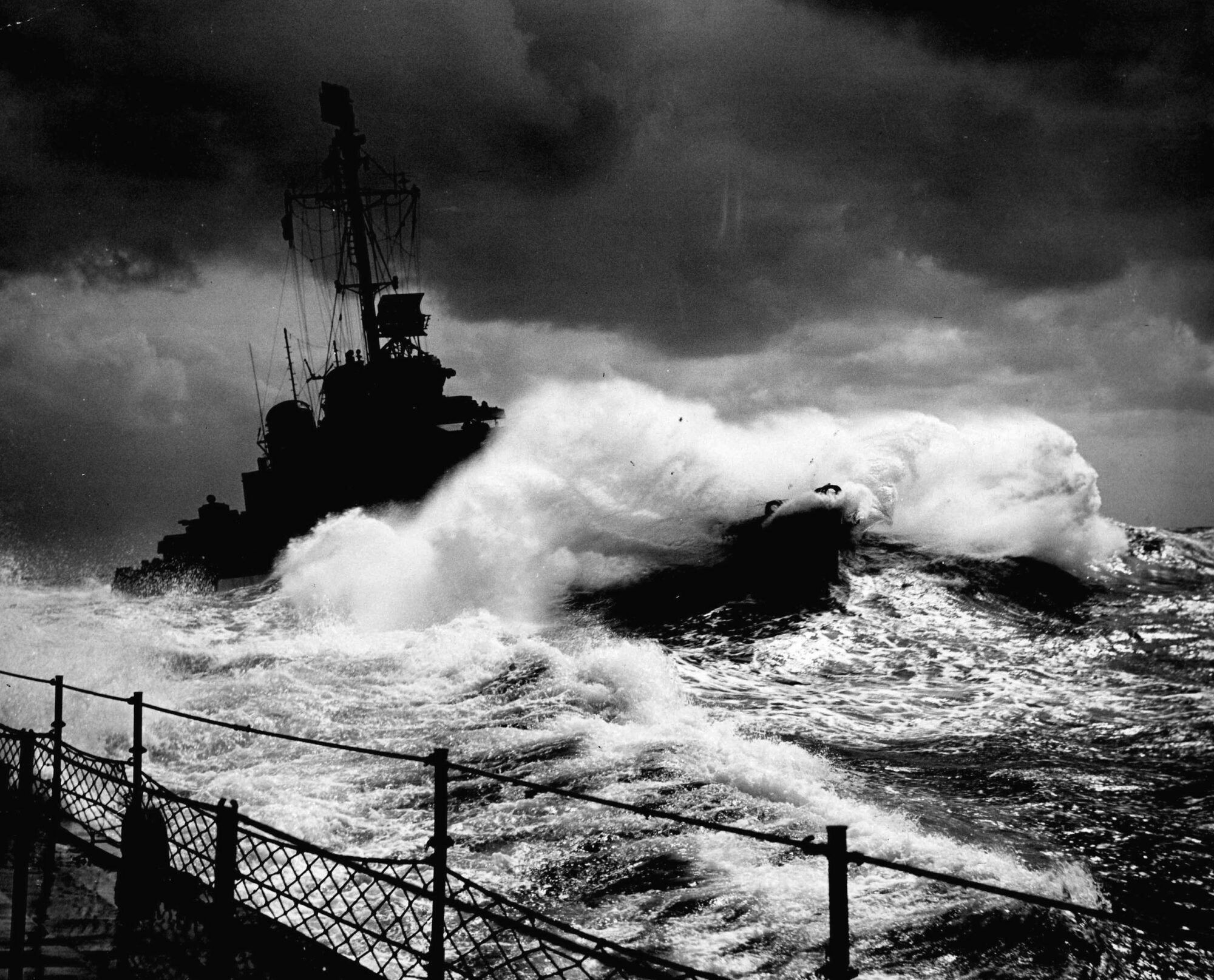
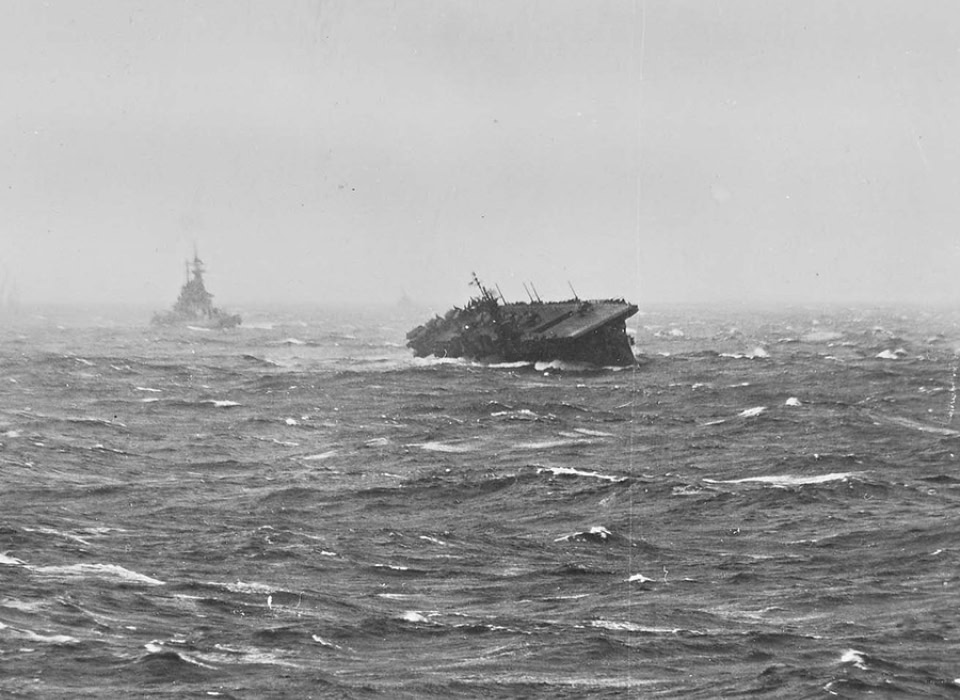
This was a massive problem for the Navy. Aircraft carriers could not operate in high, rugged seas, nor could the tankers and destroyers. Ships often were damaged by heavy storms, and enemy ships were sometimes hidden by storms.
As an extreme example, in December 1944, Task Force 38 was seriously affected by Typhoon Cobra off Luzon, Philippines. Three destroyers sank, a light carrier suffered a serious fire, and 146 aircraft were smashed, washed overboard, or jettisoned. Altogether, 27 ships were damaged and 790 people were killed.
On December 18, 1941, Admiral Earnest J. King became the Commander-in-Chief, United States Fleet with operational command over the Atlantic, Pacific, and Asiatic Fleets, and all naval coastal forces. His job was to map out the strategic direction of Naval forces and manage fleet movements accordingly. He had to have reliable meteorological forecasts to make such critical decisions.
Major Cody Chick, USA, has pointed out that “Japanese forces knew how to use weather forecasting to their advantage by screening their movements, because most of the weather formations moved from west to east across China, Japan, and then the Pacific Ocean. The Japanese had the advantage in the Pacific as they used their weather reporting system.”
Prior to the war breaking out in the Pacific in 1939, Commander Milton Miles, USN, who had extensive experience serving with the Asiatic Fleet in China, prepared and circulated a paper advocating a US Navy presence in China as a means to obtain intelligence on the Japanese, especially their technologies
Admiral King understood the weather information shortfalls. In the late 1930s, he commanded the Battle Fleet’s aircraft carriers. He had enormous energy prosecuting the war against Japan, even though US policy during WWII was “Germany first.” He supported this strategy but advocated intense pressure on Japan to hold it back. One of his daughters is said to have proclaimed her father was the “most even-tempered person in the United States Navy. He was always in a ‘rage.’” Admiral King put his foot down and actions were taken.
I mentioned earlier that in 1939, Cdr. Milton Miles wrote a paper advocating a US Naval presence in China as a means to obtain intelligence on the Japanese, especially their technologies. Miles worked with Major Xiao Bao, the Chinese military attaché in Washington, to develop a plan to implement the ideas advocated in his paper. Together, they came up with a plan with three goals,
- Monitor the weather in China as a predictor of Pacific Ocean weather
- Recruit coast watchers to monitor Japanese shipping traffic in and out of coastal China
- Prepare for a possible US invasion of China to defeat the Japanese, who were occupying it, which in turn would enable the US to attack Japan from China
In early 1942, Rear Admiral Willis “Doc” Lee became King’s chief of staff. Admiral Lee had read Miles’ paper of 1939. On the day after Japan attacked Pearl Harbor, Admiral Lee told Cdr. Miles to execute the operation he had recommended.
Admirals King and Lee told Miles to go to China. In his book, The Dragon’s War: Allied Operations and the Fate of China, 1937-1947, Maochun Yu said King’s instructions to Miles were as follows:
“You are to go to China and set up some bases as soon as you can. The main idea is to prepare the China coast in any way you can for the US Navy landings in three or four years. In the meantime, do whatever you can to help the Navy and heckle the Japanese.”
Yu said that Captain Howard T. Orville, chief of the US Naval Weather Service, was very interested in setting up portable weather stations inside China. Orville felt that even occasional weather reports would help his people develop a Pacific weather map to support long-range planning.
The Navy was reorganizing its intelligence structure as a result of the attacks on Hawaii and was hell-bent on building an intelligence capability in China.
King’s immediate priority at the time, however, was weather information. “Germany first,” yes indeed, but Admiral King envisioned conducting a large-scale amphibious assault of China in the war years ahead. His vision was to push back the Japanese so that the US could invade the Pacific coast of China and drive through Manchuria to Korea. He also saw the need to pin down Japanese forces in China, which numbered four million by this time. But first, the Navy needed a weather reporting system.
Admiral King wanted Cdr. Miles to set up weather stations inside China, which meant they had to be set up behind enemy lines.
Miles told him the Japanese had a “well-developed weather service in Asia.” This enabled the Japanese naval and air forces to conduct successful attacks throughout China and Southeast Asia.
Shortly after the Pearl Harbor attack in December 1941, the US Navy and the National Military Council (NMC) of China, chaired by Chiang Kai-shek, began negotiations to establish a weather service behind Japanese-held areas in China, and for the US to train the Nationalist Army.
Chiang Kai-shek tasked the Chinese Army's Military Bureau of Investigations and Statistics (Intelligence Bureau, similar to the CIA), led by Chinese General Tai (Dai) Li, to cooperate with American representatives on this project. The project would be known as the “Friendship Project,” which became the Sino-American Cooperative Organization (SACO).
General Tai Li was in charge and Cdr. Miles was his deputy. SACO might well have been the first American military unit to serve under a foreign leader during war.
Cdr. Miles arrived in China in May 1942. He was to work under the cover of the military attaché as a US Naval Observer to China, attached to the US embassy. Furthermore, he was to work with Xiao Bao and Tai Li, who were close to Chiang. It turned out that Xiao Bao was an intelligence agent under General Li who had been reporting back to General Li on his planning with Miles in Washington. In short, Tai Li was up to snuff when Miles arrived.
In July 1942, General Tai Li transferred 200 acres of land in a valley eight miles west of Chungking to the Sino-American “Friendship Project.” This is where Miles set up his operations.
The first group of Americans arrived in early September 1942. They were all Navy personnel and Marines trained in radio communications and radio intercepts, consisting of one officer and six enlisted men. The Americans called their location “Happy Valley.” Their numbers quickly increased to about 15. Miles had been promoted to commander in 1942 and later to captain within the same year. Over time, it grew to 2,500, and he would later become a vice admiral.
Most of the sailors belonging to SACO were Seabees, and many came from the Navy’s Scouts & Raiders because of their experience in covert operations. They served all over China and became known as the “Rice Paddy Navy.”
S. Shepherd Tate, writing “The Rice Paddy Navy, SACO and the China I Knew, commented that Happy Valley was ”Tai Li’s tight little kingdom where the headquarters was located ... Happy Valley was not really a valley, but a series of rocky hills with towering mountains behind. Rice paddies were everywhere, and armed Chinese sentries guarded every path.” As best I can tell, “Happy Valley” was simply a codename for the place.
SACO’s initial focus was on the weather. It had five weathermen assigned, and it trained Chinese for this work.
By the end of 1942, SACO had set up a “Weather Central” near Chungking. It was sending regular weather reports from multiple occupied areas in the Far East to the US fleet. China assigned undercover forces to protect the Americans.
There is much more to discuss about SACO, its relationship with China and other intelligence services, and how it evolved to become a formidable covert guerrilla warfare operation. I want to focus on its weather reporting as that dominated Admiral King’s requirement.
I’ll note that the Chinese were not interested in the weather. They wanted to fight, so they wanted training and weapons. General Tai Li commanded a large militia force called the Loyal Patriotic Army (LPA), which was active in Japanese-occupied interior regions of China. He also had connections to various Chinese bandit and pirate groups along the coast. He coveted his intelligence operations, distrusted foreigners, and was one tough cookie. Tai Li told Miles,
“The United States wants many things in China: weather reports from the north and west to guide your planes and ships at sea, information about Japanese intentions and operations, mines in our channels and harbors, ship watchers on our coast, and radio stations to send this information.
“I have fifty thousand good men … if my men could be armed and trained, they could not only protect your operations but could work for China too.”
In other words, China’s top priority was to obtain American training and equipment for its ground forces. The Chinese wanted to train their troops in guerrilla warfare. SACO did that, and I wanted you to know this. I’ll address this in a separate story. Weather tops my list right now.
Back to the weather.
SACO set up weather monitoring and radio interception stations along the Chinese coast. The weather in China was used as a predictor of Pacific Ocean weather.
Miles has said, “Our plan was to set up a weather net flanking the western extremities of Japanese-held territory.”
SACO set up 14 camps in China, three in India, and several medical facilities.
SACO established weather, communications, and intelligence stations all the way from the border of Vietnam to the northern Gobi Desert. Much of the activity was behind enemy lines along the Chinese coast. The Americans often disguised themselves as coolies. With the help of the undercover Chinese forces, they were generally able to transit enemy lines undisturbed.
At the start, the men at Happy Valley used parts from a radio that did not work to build one that would work. They jerry-rigged a direction-finding antenna, and that was the way they worked throughout the war. Supplies and equipment came, but were slow to arrive because of the war.
The radio station at Happy Valley was known as “Radio Chungking.”
Roy Stratton, writing for the US Naval Institute, has said that collecting weather information for the Pacific Fleet was the most important SACO mission so far as the Navy was concerned. He submitted that the Pacific Fleet was “blind on weather. Any sustained, large-scale, American offensive in the Western Pacific would be difficult until a mission to China could feed weather information to the Fleet.”
Stratton said SACO camps had “Seventy weather stations, stretching from the Gobi to Indochina in one direction, and from the Himalayas to the China Sea in the other, (each) sending in reports thrice daily.” He added that Happy Valley analysts would consume these reports and provide weather forecasts daily to task forces and bases.
Robert Finley Delaney, Naval War College, wrote about the influence of Fleet Admiral Earnest King. He wrote,
“The Army Navy Game begins at that point. It is the story of one man’s (Capt Miles) unremitting efforts to comply with his orders despite the odds. The odds were formidable. They ranged from OSS General Donovan (Army), who considered Miles an interloper in his clandestine fields, and General Marshall (Army), who could not gracefully accept an independent Navy command (NGC) on the mainland … Miles ultimately had only one powerful Washington friend, but it proved sufficient. His name was Ernie King.”
Lt. Frank Baillie was a Seaman First Class “aerographer striker” in 1948. He said “two-person weather units consisting of a weatherman and a radioman” along with Chinese guerrillas were located along with coast watcher units. He indicated they trained Chinese to work as weathermen as well.
Dean Warner enlisted in the Navy and was sent to Radio School and the Signal Corps. After a while, he was sent to Washington, DC, for a “secret thing.” Then he was off to Bombay, India, after which they flew over the “Hump,” the Himalayas, to Kunming, after which he was flown to SACO Camp 6 at Changchow (Zhangzhou), close to China’s east coast and across from Formosa (Taiwan).
Warner commented,
“They sent us out with a radioman and either a gunner's mate or bos'n's mate, a Chinese weatherman, and a Chinese interpreter, and six Chinese guards, and we’d go to a little fishing village right on the coast of China. There our job was to give a radio communication every six hours on weather and watch for Jap shipping along the coast.”
They encoded their reports and sent them by manual Morse code.
Robert Hill was among those who set up the radio station at Kunming. Following this, he was sent to the coast, only 35 miles from Amoy Island, to be a coast watcher. He went with one other American and 10-12 Chinese soldiers. He was then in a unit of coast watchers and weathermen, 15-20, with a doctor and a pharmacist. He was with a Chinese weatherman who sent up a weather balloon that gave them weather readings, which they would transmit every night and every morning to HQ.
The weather balloon carried a radiosonde, which transmitted weather data back to ground-based receivers. It measured atmospheric pressure, temperature, and humidity. It would rise for 60-90 minutes to an altitude that would cause it to burst. It had a small parachute to bring it safely back.
Camp 4 was in northern China at Shenpa and was SACO’s northernmost camp, located at the southern edge of the Gobi Desert. The men used a Catholic mission outside town. The initial group was 12. They set up a radio antenna and a direction finder. Their station monitored the weather daily and sent out daily weather reports. Camp 4 was primarily a weather station, though guerrilla warfare training was provided.
Linda Kush reported that Camp 4 was a “most important weather station,” located 400 miles north of Tokyo, able to “track weather patterns crossing central Asia to the Pacific sooner and more accurately than the Japanese.”
Camp 5 was in Kwangsi in southwest China, close to the Vietnam border. It occupied an old French Mission. Their mission was to train guerrillas. The radioman sent out intelligence reports and broadcast weather reports for southern China every three hours at the request of the 14th Army Air Force (AAF), which flew missions from Chinese bases.
The Naval History and Heritage Command said,
"SACO weather observers and other agents equipped with radio communicated intelligence promptly to SACO headquarters where the information was analyzed, condensed and flashed directly to Pacific Fleet Headquarters and to listening air, surface and submarine units at sea. Fleet operations in the Western Pacific made the most of China weather reports, especially in planning and executing hazardous carrier strikes despite the treacherous weather conditions prevailing near Formosa and the Japanese home islands.”
As one might expect, the SACO mission expanded greatly and quickly. Linda Kush, writing “The fighting’ forecasters: The US Navy in China in World War II,” wrote:
“Their (US-ROC through SACO) cooperation evolved into a multifaceted operation. In addition to weather monitoring, SACOs spied on Japanese troops and ships, blew up enemy supply depots, laid mines in rivers and harbors, rescued downed American pilots, and trained thousands of Chinese soldiers in guerrilla warfare. Navy aerologists thus found themselves in multiple roles, engaging Japanese forces and training Chinese recruits both as soldiers and weather technicians.”
By 1944. SACO had about 3,000 members from the Army, Navy, Coast Guard, and Marines, of which only about 750 served in Happy Valley. The other 2,200 were in the field.
Maochun Yu wrote,
“Chinese and Americans fighting together as guerrillas, running weather stations, radio direction and intercept, intelligence gathering of all kinds including targets by land and sea, sabotage, anti-sabotage, location of spies, rescue of pilots . . . [operating] from the Gobi desert to Siam, from the Pacific to Burma.”
That’s a handful of work. There are some great stories to go with it. O hope to report on some later.
Click to zoom graphic-photo