Kamikaze attacks USS Comfort hospital ship
“Kamaretta red, smoke boat make smoke"
Kamikaze attacks USS Comfort
The USS Comfort (AH-6) evacuated patients from the battles in the Philippines and stood by off Okinawa from April 2-9, receiving wounded.
The USS Hope (AH-7) arrived in Okinawa on April 9, and the USS Mercy (AH-6) arrived in mid-April. Both were Comfort-class hospital ships, and both sailed back and forth to deliver patients to Saipan.
The USS Relief (AH-1) had been operating near the Caroline and Palau Islands, southeast of Guam and north of New Guinea. She took on 759 casualties and took them to New Caledonia, east of Australia. She then took 489 patients to San Francisco, after which she was overhauled.
Relief was designed from the ground up as a Naval hospital ship and had a bed capacity of 550. The medical staff and crew were Navy. After the overhaul, she went to the Carolines.
A kamikaze attacked the USS Randolph aircraft carrier on March 11, 1945. Relief took aboard the casualties and took them to Guam.
The Relief and Comfort met up and arrived in Okinawa on April 2. Japanese bombers attacked Relief, but only one bomb landed nearby, causing slight damage.
The Comfort trailed the Relief by about 1000 yards. For now, the Relief's skipper assumed the duties of Officer in Tactical Command for both ships.
As they entered the combat zone, they could see and hear the extensive naval bombardment of the island, and the airways were filled with aircraft from both sides.
Soon afterward, the two hospital ships, fully lit, drew the attention of a Japanese fighter. It first crossed the bow of the Relief, then swung around and came at both ships bow-on, dropped a bomb, and fired its cannons. Water splashed from the strafing on the sides of the ships. The Relief passed over the bomb before it exploded. Luckily, the damage was minimal, but the Relief was jostled around a bit in the water.
The USS Wickes (DD-578), a destroyer conducting radar picket and fighter-direction duties, spotted the action over the horizon on her radar, steamed over, and opened fire. The Wickes hit the attacking fighter just as it released its bomb, probably explaining why the Relief avoided a hit.
A few hours later, another fighter flew around the hospital ships, but did not attack.
By the time Relief and Comfort arrived, the invasion of Okinawa was in its second day. Both ships approached the beaches and anchored offshore, taking on casualties almost immediately. Enemy aircraft occasionally flew nearby, but none fired.
At night, it was considered best for the two hospital ships to move about 80 miles offshore, where they could be more isolated and fully illuminated to aid identification. The crew often said they were “Lit up like Christmas trees.”
They returned to the anchorage area in the morning. An anchorage area is a place where ships can safely drop their anchor. The medical staff worked around the clock to care for the patients on board. The ships followed this routine until April 8.
The kamikaze raids became so frequent that, starting on April 9, the two hospital ships remained in the anchorage area with their lights out, using smoke screens for cover. As a result, they lost their immunity.
Lt. Gardner’s daughter reported that the “coming and going proved to be too much for the ship, and the Comfort stayed in harbor overnight, their lights out.”
Ann Bernatitus, Capt., USN (Ret.), shared her oral history about her service as a USN nurse in the Pacific during WWII. She served aboard the Relief and described this anchorage procedure:
“When we stopped retiring out to sea at night, all lit up, we would stay where we were anchored, ready to pick up casualties. Every time the kamikazes came, we got an alarm over the loudspeaker. They would say ‘Kamaretta red, smoke boat make smoke.’ And then this boat would fill the bay with white smoke so the kamikazes couldn't see.”
Ships under the smoke screen were not supposed to fire lest they reveal their position. The problem was that the wind could shift suddenly, leaving everyone exposed. Sometimes, the smoke cover only lasted a few minutes, but an attacking aircraft could see the ship clearly and would attack.
While out to sea, the hospital ships received numerous attack alerts. The crews could watch the kamikazes in action, sometimes striking their targets, mpore often than not crashing into the sea after being shot down. On at least one occasion, while retiring to sea, a kamikaze passed right over the hospital ships on its way to crashing at sea.
By April 9, Comfort was filled to capacity with patients, and she left for Guam.
By April 10, Relief’s patient capacity was filled, so she headed for Saipan to transfer her 556 battle casualties.
During their sailing, Relief intercepted a message indicating Comfort was under aerial attack. Comfort was a short distance off Relief’s bow at the time. Neither ship was hit or damaged, but Comfort was delayed in port at Guam for one day.
In the meantime, the Marines on Okinawa had achieved their objectives and headed south to reinforce the Army.
The fighting at the Shuri line was furious. The Army divisions broke the first line of defense, but the Japanese fell back to the next line of defense, which consisted of limestone and coral landscape and ridges. From their positions, the Japanese, in smaller numbers, could inflict heavy damage on the assaulting US Army.
SSgt. Rudy Frame, Jr., USMC, wrote about the Battle of Okinawa, which he called “the final great battle of WWII.” Frame wrote,
“As the first defensive ring was eliminated, the Japanese troops simply withdrew to the second defensive line, which was the most heavily fortified and intricate. This line utilized every natural and manmade advantage that it could, incorporating them into an ingenious defensive strategy. The limestone and coral landscape was used as natural cover while every single weapon employed was mutually supported by other combined arms assets. Every ridge was honeycombed with defensive positions allowing the Japanese to always hold the high ground and employ relatively small numbers of infantryman, machine-gunners, and mortar-men against a numerically far-superior adversary who had to move through ravines, across rivers, and up hills resulting in a dramatic advantage for the Japanese.”
The USS Relief returned to Okinawa on April 22, and the Comfort arrived on April 23, during this bloody battle in the south.
Relief delivered a complete field hospital unit to Okinawa and departed on April 26, bound for Tinian Island with 613 casualties. Comfort remained on the scene.
USS Hope and USS Mercy sailed back and forth to deliver patients to Saipan.
It’s now April 28, 1945. The Comfort had returned to Okinawa and was 50 miles offshore under a full moon. She was fully lit. The Comfort loaded up as many patients as she could handle, over 500. The surgery was filled, and the sights of amputations, shrapnel, bullet extractions, and attempts to provide relief were gruesome. Comfort planned to sail to Guam.
Estimates indicated that the Japanese dispatched 168 aircraft on April 28 to celebrate the emperor’s birthday. It was described as a clear, moonlit night. The kamikaze air attacks were fierce.
William Benton, aboard the USS Callaghan (DD-792), a Fletcher-class destroyer, stated that the Comfort was always well-lit; she was painted white, and the red crosses were clearly visible.
Barbara Tomblin, in her book, GI Nightingales: The Army Nurse Corps in World War II, wrote that Comfort was 50 miles offshore of Okinawa. Tomblin wrote,
“The first crewman to spot the attacking Japanese plane was Seaman 1st Class Elmer C. Brandhorst, who was on watch on the bridge (of the Comfort). ‘I saw the plane first when it made its first dive, but it was too dark to identify it as enemy or ours. About ten minutes later I saw it again, coming in dead ahead in a steep dive,’ he told reporters for Base Hospital No. 18’s newspaper.”
Bill Fadden said this was intentional; the ship was outside the battle area and properly lit. The Japanese had threatened to attack hospital ships, asserting they were returning wounded men to combat.
The kamikaze single-engine fighter came in low and overflew the Comfort. He had flown from Formosa (Taiwan), some 400 miles to the southwest, most likely having to dodge US fighters and perhaps even some flak from destroyers. I have not seen a firm identification of aircraft type. Still, most accounts say it was a single-engine fighter, so I suspect it was either an Aichi D3A dive bomber, nicknamed “Val” by the Allies, or perhaps the Nakajima Ki-115 “Sabre”, which was built for kamikaze flights.
At any rate, the kamikaze circled twice, thinking about the best way to attack this hospital ship. I am sure he knew the ship carried hundreds of wounded aboard. He could see this was a hospital ship. There is no doubt about that.
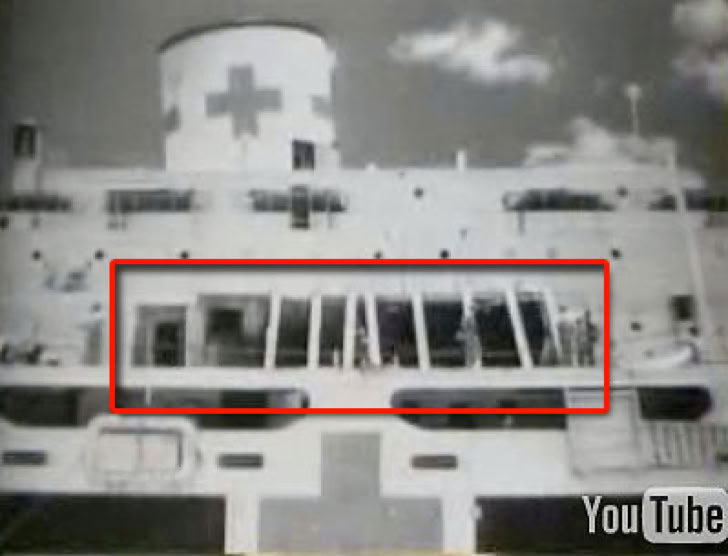
After circling, he climbed to his chosen altitude, then dove straight at the red cross on the ship’s side, crashing into the superstructure, which is the part that rises above the main deck. He crashed through three decks before stopping on the second deck.
It’s hard to know what was on the mind of this kamikaze pilot. His feelings were most likely quite complex. Kamikaze in Japanese means “divine wind.” He was part of a “special air attack unit.”
His leadership knew Japan was losing the war, some even saying they had lost it, a horrible, untenable thought for many. Some were university graduates, plucked for this mission. They were young, 17-24.
The most kamikaze attacks in WWII occurred during the Battle of Okinawa. They did considerable damage, sinking 36 ships and damaging another 368, resulting in about 5,000 sailors KIA and another 5,000 wounded.
The employment of the kamikaze was a defensive strategy. The idea was to sink as many US ships as possible; they did inflict damage, but most of their attacks failed. Orders to fly such a mission were given as an act of desperation.
When in training, many kamikaze pilots were treated poorly by their leaders, often hazed and even beaten. The training was minimal essential. Nothing special. Captain Rikibei Inoguchi, the Navy Chief of Staff of the First Air Fleet during the Philippine Campaign, told his interrogators,
“The center of Kamikaze is morale. To achieve Kamikaze, the ordinary technique of the pilot is sufficient, no special training methods are necessary.”
Bertam Vogel, a post-WWII interrogator fluent in Japanese, has said he believes that most were experienced pilots. Vogel wrote that the plan was to fly high to avoid an air battle with US pilots, and, when the target had been sighted, drop to about 1,600 ft. and perform a 45-degree dive at the target.
Most kamikaze pilots were volunteers, bound by honor in defeat and their culture. This flight for many was part of a ritual, for some, a sense of fatalism; typically Japanese at the time.
Not all went through with the attack, returning to fly another day, perhaps with aircraft malfunctions, or they could not find their target, or they might crash land on an island and hope for the best. Many were like others, wanting to return home to their families, yet obligated to avenge their comrades who had fallen for the emperor.
The Japanese pilot flying directly at the Comfort was certainly intent on completing his mission. He was a good pilot, perhaps even an excellent pilot. He knew this was a hospital ship. He had a few moments while circling his prey to think about how best to attack the ship, how he could do the most damage. He targeted the red cross on the ship’s side and, as it turned out, smashed directly into the ship’s operating room.
When the attack occurred, there were nine surgical tables set, and the room was very active.
Water rushed in, and the skipper became concerned that the Comfort could capsize.
Brandhorst was wounded in the arm and right leg by flying pieces of metal from the plane when it hit the ship's superstructure.
In the ship’s surgery below, operating teams were at work when the kamikaze hit. The force of the impact hurled the plane’s motor through the surgery, igniting oxygen tanks and causing a tragic explosion. All medical personnel in the operating room were killed.
Christopher Klein, writing for The National WWII Museum, has said the kamikaze went straight into the surgery unit, killing six nurses, four surgeons, and seven patients.
Lt. Doris Gardner has said,
“The kamikaze pilot struck the Comfort right through to the core of the hospital’s duties, the surgery. Surgeons, nurses, and wounded were killed instantly. The heart of the ship stopped beating and went dark.”
All three operating rooms were destroyed.
Lt. Evelyn Bachelor of Pocatello, Idaho, was the only nurse in the surgery to survive the attack. Mert, Dorrie, and Mary shared a stateroom with her. Bachelor was thrown by the explosion into the stirrups supporting a patient undergoing pelvic surgery. The patient died.
Major Dorsey Brannon had just finished his surgery, was dressing a patient, and was blown through the windows. He escaped with some cuts on his hand.
I have seen a video recap of the event that said two remaining surgeons were blasted out of the operating room to the weather deck, shocked but back at work the next day.
The kamikaze’s engine went all the way down three decks and killed a cook in the galley. Fires broke out, but the Navy crew extinguished them.
Nathan N. Prefer has written that Lt. Gladys C. Trosstrail “was tossed across the room, through the bulkhead, and found herself regaining consciousness while trying to avoid drowning from water pouring down from broken pipes. An enlisted man pulled her to safety.”
Lt. Valerie A. Goodman was helping another nurse prepare penicillin injections when the enemy plane hit. She was trapped under the bulkhead by the blast. The nurse next to her was killed instantly by the explosion.
Lt. Doris Gardner said she was just coming on shift in the post-op ward when the kamikaze struck. She said she only weighed 85 lbs. and was blown over with her spine and head hitting up against the bulkhead.
A medic came to her and saw the ship was taking on water, shooting high vertically. The ship was listing. Crewmen swam into the water with submersible pumps and by daybreak had corrected the ship’s dangerous list.
Doris refused to leave her patients. There was an order mistakenly issued to abandon ship. Nonetheless, Doris said,
“I was in shock, dizzy, trembly, and soon found that I couldn't hear anything but the roaring in my head, nor could I see too clearly.”
She was left deaf for a while and used hand signals to communicate with the patients. One of them required oxygen to breathe, and thankfully, the tank remained whole. There was a danger it could explode, which might have wiped out the ward.
Mert Onsrud was leaving the surgery room when she was thrown from the explosion and suffered severe head injuries. She was hospitalized for over a year. She retired as a lieutenant colonel and eventually became the Director of Nursing at Lutheran Hospital in La Crosse.
Corporal George Vondracek, a surgical technician who was also trained as a dental surgery technician, was working with another medic but had temporarily walked to the end of the ward to retrieve his watch, which he had left on the desk. He said the kamikaze came through the overhead and continued across the deck in his ward, stopping about 20 feet in front of him. He reported that six patients and his fellow medic were killed.
The ship was severely damaged, leading to the destruction of critical areas such as surgical and X-ray facilities, several offices, and the central supply room. The pharmacy and dental clinics were also heavily damaged, as were wards one and two on the superstructure deck. Wards 1-3 and 1-5 on the main deck were destroyed. Several other parts of the ship were also severely affected.
The nurses had earlier discussed what they might do if their ship were hit. They knew the Comfort did not have enough lifeboats for everyone and suspected some or all of them would have to stay with their patients if that happened.
The abandon ship order was rescinded. Doris and the medic determined their patients were all okay. The ship made its way to Guam.
At one point, Doris Gardner thought more than 100 were killed. Frankly, I have seen varied reports on the number of killed and injured. Tomblin said 27 were killed. I have seen 29 and 30. I will say 30 were killed. I believe those saying 29 were concluding there was one Missing In Action (MIA), but I believe he was later listed as Killed In Action (KIA).
In her book, Barbara Tomblin said,
“In all, one Navy and four Army medical officers, six Army nurses, one Navy and eight Army enlisted men, and seven patients were killed by the Japanese plane or by explosions that followed its impact. Another ten patients, seven sailors and thirty-one soldiers, four of them nurses, were wounded.”
All hands continued duties as assigned. They set up a makeshift first aid station immediately, repurposing nearby offices and the barbershop to serve in this capacity as well. They set up two more dressing stations in the mess halls. They moved less critical patients in the wards to free up beds for those injured in the blast.
The medical team issued an urgent request for surgeons and surgical instruments, but decided the next day that those were not needed.
The medical teams and the navy crew spread confidence as they brought everything under control.
The USS Stringham (DD-83) destroyer rendered assistance and was relieved by the USS Wickes (DD-578).
The mangled body of the Japanese pilot was recovered along with papers on him. Those papers were sent to Naval Intelligence. Christopher Klein commented, “A document found with his body listed potential targets that included hospital ships.”
The Comfort was patched up in Guam and returned to Los Angeles, arriving there on May 28, 1945, where she underwent repairs. She then sailed to Subic Bay, Philippines, in September and remained there until mid-October to serve as a station hospital ship. The Comfort returned to Okinawa and returned to San Pedro on December 11, 1945.
The Battle of Okinawa continued into June 1945. US forces secured the island in late June, but Japanese soldiers hidden in caves popped out here and there in the days and weeks that followed.
The USS Comfort was decommissioned in April 1946.

Click to zoom graphic-photo
Click to zoom graphic-photo


Ed Marek, editor

Marek Enterprise
224 N Barstow St Suite 426
Eau Claire, WI 54703
© Copyright 2025
