Corps d’Afrique
A painful evolution to prove valor
Prologue
The Civil War began on April 12, 1861, with the Confederate bombardment of Fort Sumter, South Carolina. Seven Southern slave states had earlier seceded from the US. They formed the Confederate States of America (CSA). Four more followed after that, bringing the total to eleven by June 20, 1861.
Drew Gilpin Faust wrote:
"In the middle of the nineteenth century the United States embarked on a new relationship with death, entering into a civil war that proved bloodier than any other conflict in American history … Death's significance for the Civil War generation derived … from the way it violated prevailing assumptions about life's proper end — about who should die, when and where, and under what circumstances."
The war ended May 12-13, 1865.
Gary Gallagher underscores Faust’s assertion that the US “embarked on a new relationship with death,” writing,
“Four years of fighting claimed almost 1.5 million casualties (killed, dead from disease, wounded, or taken prisoner, and of whom at least 620,000 died) directly affected untold civilians, and freed four million enslaved African Americans.”
One is well advised to keep it in mind.
Introduction
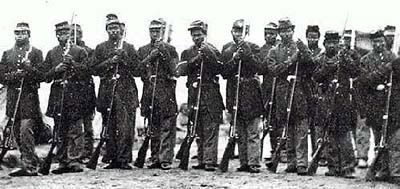
This story centers on the Corps d’Afrique, black soldiers who fought for the Union in the American Civil War. That war was and remains a central event in American history. The Corps did not develop overnight. Theirs is a complex story, an evolutionary story that began in Louisiana. It will expose you to a great deal of American history, good and bad. Emancipation and military service in this war were woven together, much of it done through experimentation, and much a reflection of the complexities of society and government.
There was a historical precedent for the US to use blacks in war dating to the War of 1812. Major General Andrew "Old Hickory" Jackson, USA, used New Orleans as his base of operations beginning in November 1814. The British far outnumbered the US forces. Blacks were mightily involved in the defense of the city. Free black men 45 years and older formed home guards behind the front lines to protect property and maintain order, build defenses, fortify positions, and fight as needed. Black women provided clothing and medical aid.
Louisiana at the time had two battalions of free men of color, over six hundred men, who fought along with Jackson's Army forces. An act passed by the Louisiana legislature in 1812 was the first in the nation to authorize a black volunteer militia with its black line officers. Keep this in mind as we proceed.
Abraham Lincoln became president on March 4, 1861, just one month before hostilities. Seven states had already seceded and formed the CSA. In his inauguration speech, Lincoln said:
“I have no purpose, directly or indirectly to interfere with the institution of slavery in the United States where it exists. I believe I have no lawful right to do so, and I have no inclination to do so.”
Two years later, Lincoln issued the Emancipation Proclamation on January 1, 1863, declaring slaves free in 10 states as an action to suppress rebellion. Those states not in rebellion did not fall under the proclamation. Lincoln fretted a good deal when he did this.
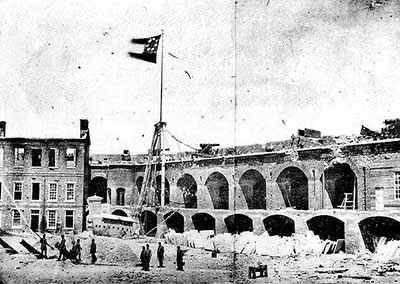
Confederate forces seized numerous federal forts within what they saw as their territory. This photo shows Ft Sumter, South Carolina, under the Confederate flag.
Compromise would not work. Lincoln, as one of his first acts, ordered the Navy to blockade southern ports on April 19, 1861. There were naval battles in North Carolina, South Carolina, and Virginia. Then came New Orleans in April 1862. There were many more battles, mainly inside the Confederacy, thereafter, but I will stop here as New Orleans is a focal point for this story. As an aside, the Confederates won a fair share of these battles, and there were multiple times the Union Army appeared as though it could not cope.
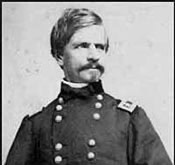
Major General National P. Banks of the Union Army proposed the Corps d’Afrique, using colored troops, on May 1, 1863. It became official in June 1863. There is quite a story here, not well-known, but it deserves attention.
While most of us might not have known about the Corps, there is a lot of excellent information available about it. As with so many topics, the challenge is to assemble the particulars such that one can follow its evolution. The march from war in 1861 to the Corps d'Afrique in 1863 was a long evolution, most notably on the northern side of the Mason-Dixon Line, including Abraham Lincoln.
African Americans serving in the Confederate Army is a controversial subject. The Confederate Congress disapproved of blacks being enlisted as soldiers. However, many Confederate officers ignored that ruling, enlisting blacks so long as they would fight.
Shirley Farris Jones, a trusted Civil War historian, has reported:
"It has been estimated that more than 65,000 Southern blacks served in some form or fashion in the Confederate ranks, and more than 13,000 of these 'saw the elephant,' a term used to describe meeting the enemy in combat. These black Confederates included both slaves and free men."
She also noted that other historians have estimated the number to exceed 100,000, most of whom were impressed into service as laborers, etc.
Jones goes on to say:
"Free black men served the Confederacy as soldiers, teamsters, musicians, and cooks. They earned the same pay for their service as did white Confederate privates, which, in the Union Army, was not the case. They also earned the wrath of their fellow black men of the North … Horace Greeley, observing the differences between the two warring armies, commented: 'For more than two years, Negroes have been extensively employed in belligerent operations by the Confederacy. They have been embodied and drilled as rebel soldiers and had paraded with white troops at a time when this would not have been tolerated in the armies of the Union.'”
However, John Corski, a historian with the Museum of the Confederacy, has said, “No significant numbers of enslaved or free African-American men served in the Confederate Army as soldiers, as defined by commonly accepted criteria.”
Corski argues that there were unquestionably ”tens of thousands of enslaved and free African Americans who served with the Confederate armies as body servants, laborers, teamsters, hospital workers, and cooks. But were these men ‘soldiers’ in any real sense of the word?”
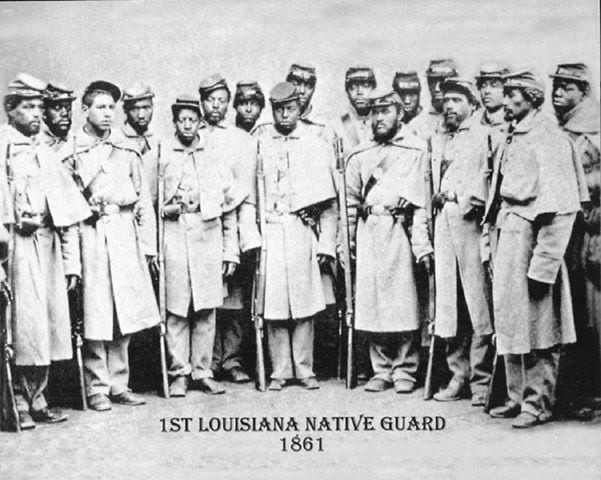
Louisiana Governor Thomas O. Moore, himself a plantation and slave owner, formed the 1st Louisiana Native Guard, CSA on May 21, 1861, making it the first official black regiment in the Confederate Army. All of the initial members, some 1,100, were French-speaking Creoles.
The 1st Louisiana Native Guard, CSA, formed by Governor Moore accepted Creoles, but not negroes. This demarcation would continue to show up during the evolution of the Corps d’Afrique. The label “Creole” can mean a lot of things. It usually refers to native-born, in our case, native born Louisianians. The French settlers used the term to distinguish people born in Louisiana from those who came from elsewhere. Most of those born in Louisiana were of French ancestry, or sometimes of Spanish descent. The term was also applied to African-descended slaves born in Louisiana. Some say the term distinguishes between classes, referring to Creoles as an elitist structure. Still others define the Creole by skin color.
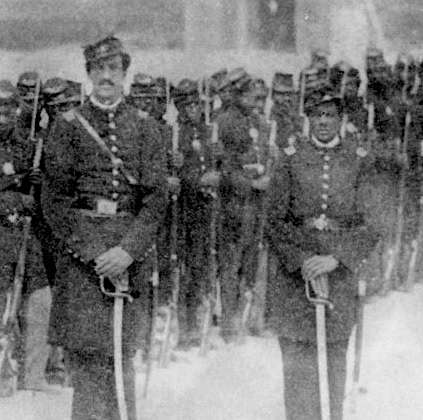
The governor appointed three white officers to command the regiments. However, company officers were Creoles selected from the ranks.
The free men of color in New Orleans were enthusiastic about the Confederate cause. During the period before the Civil War, Louisiana’s free people of color were well accepted and often prosperous. Their numbers, however, were small.
Feelings changed as the Civil War approached. Many southerners grew concerned that the free people of color would collaborate with the abolitionists. Others also saw their existence as a threat to the system of slavery. The idea of white supremacy grew even louder and more aggressive. As a result, many free men of color left the state. Finally, some shuddered at the idea of free people of color killing whites.,
For reasons just outlined, the unit did not last long. The state did not supply it well. Its members often had to provide their own weapons, ammunition, and clothing.
Then came the political hammer. In January 1862, the Louisiana State Legislature passed a law that required militia members to be white. On February 16, 1862, the 1st Louisiana Native Guard, CSA, disbanded. However, it reappeared as an element of the Union Army later, in September 1862.
I will focus on Louisiana because that’s where the Corps d’Afrique had its roots. If you’re going to talk about Louisiana, you have to talk about New Orleans.
Before proceeding, I want to touch on some terms I use in this report.
This is a historical report. I use the word “slave” to describe a historical condition where people were subjected to involuntary servitude. These people were enslaved, owned as property, and forced to work without personal freedom or rights. Bondage was an imposed condition, not the person's inherent identity.
The word “slave” was employed a great deal in the 19th century. I also use the words “colored” and “negro.” I do this for the same reason: these words were used back then. Use of these words as they were used then underscores what conditions were like during the Civil War. Their use gives you a better sense of the depth of slavery’s moral injustice.
I also use the term “free blacks.” The term means some slaveowners voluntarily freed their slaves, for a variety of reasons and following varying timetables and approaches.
I will also highlight that many slaves escaped from their owners. They were known as fugitive slaves and runaway slaves. That slaves would try to escape is as old as the institution of slavery.
There is an excellent paper on the subject done by Leone Bennett, Jr., at the time the senior editor, Ebony Magazine, entitled, “What's In a Name? Negro vs. Afro-American vs. Black.”
Click to zoom graphic-photo